Champagne Gold Trim Colour Problems: How to Tell What Actually Caused It
Two strips of the same champagne gold, from the same order, on the same wall — and one of them reads warmer. The reflex is to blame the coating, reject the batch and lose three weeks.
Most of the time the coating is fine. The cause sits somewhere else: in how the order was split, in which surface the coating was laid on, or in which lamp is doing the looking. Wrong diagnosis is the expensive kind — it replaces material that was never the problem and leaves the real cause in the building.
Six symptoms account for nearly every colour complaint on a PVD trim project. Each one has a different owner, a different fix, and a different point at which it became unavoidable.
Match the symptom before you match the colour
| What you see | Most likely cause | Where it was decided | What to do |
|---|---|---|---|
| One wall is lighter at one end | Film thickness gradient inside the chamber | At coating | Replace the run. Do not “use the dark end where it won’t show” |
| Floors 1–5 warmer than 6–10 | Two coating runs | At purchase order | Accept or replace the later phase; fix the split for the next one |
| Same colour looks different at the niche and the panel | Different base finish — mirror vs hairline | At design | Change the design line, not the material |
| Correct by day, grey by night | Light source and metamerism | At sample approval | Re-approve under the project lamp |
| Marks appear after handover | Cleaning chemistry or site residue | At handover | Clean to a written method; check before blaming the coating |
| Dark, lifting edges at cut ends | Cutting practice and edge treatment | At installation | Deburr, passivate or cap; change the blade |
Read down that table and the useful fact is this: only two of the six are coating faults. The other four were decided by people who never see a coating chamber.
Symptom 1 — one wall, two tones
A single wall with a visible light-to-dark gradient is the one case where the coating is genuinely at fault.
How to confirm it in five minutes
Lay three strips from the same bundle side by side on a neutral grey surface, in the same light, and photograph them together with a card in frame. If the gradient follows the strips — the same end of each piece lighter — it came out of the chamber. If each strip is internally even but the wall still reads patchy, look at the substrate: tile shade variation and joint width produce the same impression with no colour difference at all.
Why you cannot sort your way out of it
Sorting light pieces to one end of a room works on a floor. It does not work on trim, because the strip runs 2.4 m and the gradient runs along the length of every piece. Sorting redistributes the problem and hands the decision to a tiler who has no authority to make it.
Practical note: a gradient of this kind is a whole-run issue. Raise it as a non-conformance against the delivery, with the comparison photo and the date, before any of it is fixed.
Symptom 2 — floors that don’t match
Levels 1–5 warm, 6–10 cooler, and both were “champagne gold” on the same schedule. This is the most common complaint in the trade and the least mysterious: two coating runs, usually months apart.
The owner is the purchase order, not the factory. A coating line holds a colour tightly inside one run; it cannot make July reproduce March once the target has been re-mounted and the gas flow re-tuned.
What to do depends on where you are in the programme:
- Before production: put the total quantity and the delivery schedule in front of the factory at quotation stage and ask for one run with staged packing.
- Mid-programme: leave the installed phase alone and bring the remaining phases onto the original master. Replacing a good floor to match a bad one is the wrong direction.
- At handover: if the mismatch is visible only between floors and not within a floor, document it and move on — that is exactly what the tolerance clause is for.
Symptom 3 — same colour, two surfaces
This is the most frequently misdiagnosed of the six, and the one that generates the most supplier disputes, because nothing is actually wrong.
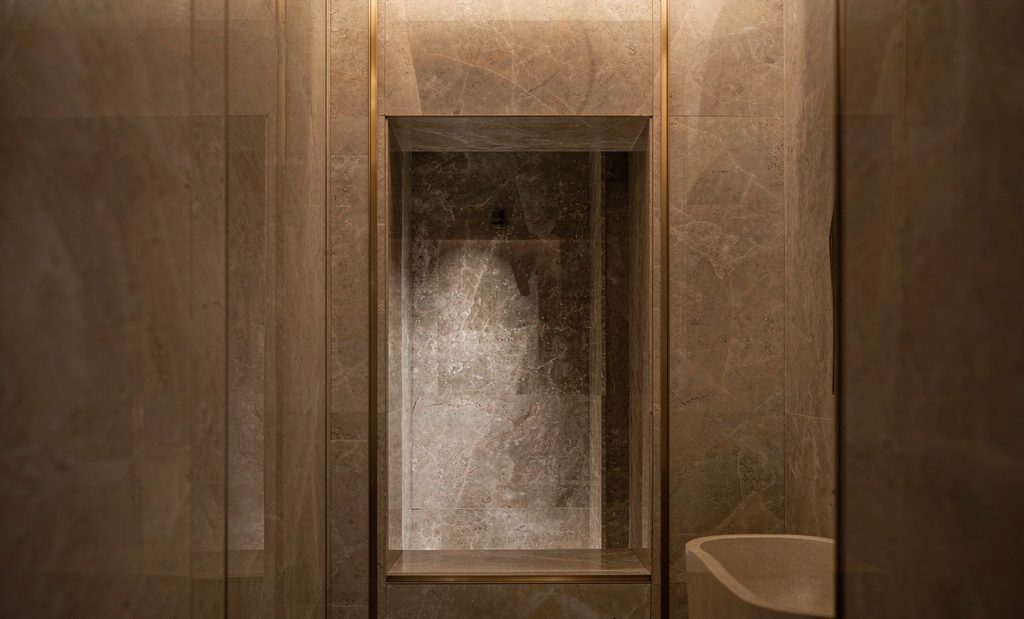
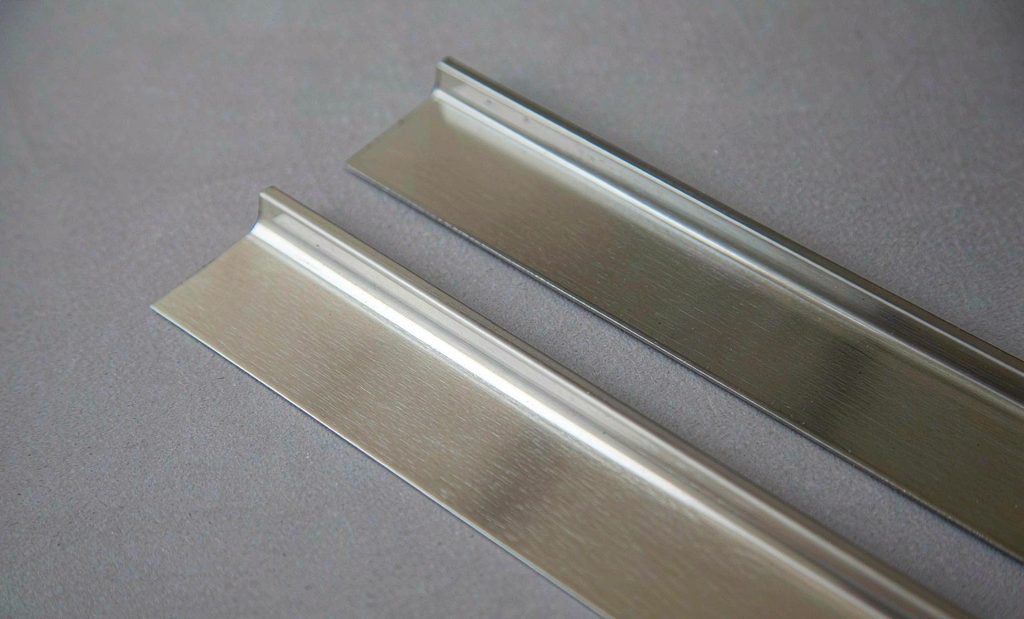
Champagne gold on a hairline base scatters light and reads soft and pale. The identical coating on a mirror base returns light and reads deep and saturated. Put them in the same bathroom — mirror on the feature panel, hairline on everything a hand touches — and you have two colours from one order.
The comparison that ends the argument
| Base finish | How the colour reads | Where it belongs | What it hides |
|---|---|---|---|
| Mirror | Deep, saturated, high contrast | Feature panels, niche backs above hand height | Nothing — every mark shows |
| Hairline | Soft, pale, low contrast | Skirtings, door reveals, anything touched | Fingerprints, cleaning marks, fine scratches |
| Satin / No.4 | Between the two, even | Large flat runs, wall cladding | Light marks only |
Three things settle it at design stage instead of at snagging:
- One base finish per continuous view. If a guest sees both surfaces without turning their head, make them the same.
- Put the change on a designed line — a shadow gap, a door reveal, the underside of a shelf. A change on a straight run reads as a mistake; a change at a junction reads as a detail.
- Approve the two finishes as a pair, on one approval sheet, at the same time.
Where the wall carries both anyway, a shaped profile hides the difference better than a flat strip. The T- and U-shaped decorative profiles break the surface into planes, and each plane catches light at a different angle, which absorbs the small tone shift a flat 10 mm face would expose.
A bathroom also rarely uses one profile. It uses a set — edge trim, shadow gap, cladding return, shelf — ordered at different times as different line items. Specify the set as one colour and one finish family; the selection points in choosing stainless steel moldings for bathroom walls apply to every piece in the wet area, not just the one at the tile edge.
Symptom 4 — correct by day, wrong by night
A sample that matches under the showroom’s 4000K downlights and turns grey in a 2700K guest bathroom is not a defective sample. It is metamerism: two colours that agree under one light source and separate under another.
Champagne gold is a low-chroma warm metal, which makes it unusually sensitive to this. It also shifts with viewing angle, so a corridor view and a head-on view of the same strip are not the same reading.
Verify it in ten minutes
Take the strip into the room it is going into, at night, with the room’s own lighting on. Look at it from the door and from 500 mm, and compare against the master in the same position. If it reads correctly there, it is correct — the showroom was the wrong place to judge it.
This is also why the move toward satin champagne and rose gold has changed the approval process and not just the palette. The shift away from matte black has taken the market into the colour family that is hardest to hold and the first to expose a lighting mismatch.
Symptom 5 — marks that appear after handover
Three months in, the trim looks dull, patchy or streaked, and the first assumption is that the coating has failed. Usually it hasn’t.
| What it looks like | What it usually is | How to tell |
|---|---|---|
| Milky streaks along the grain | Cement or grout residue never rinsed off | Wipe with pH-neutral cleaner, rinse; if it lifts, it was residue |
| Brown bloom in spots | Tea staining — airborne chloride and moisture | Localised; cleans off, returns in the same place |
| Fingerprints that will not wipe off | No anti-fingerprint layer on a hairline face | Compare against an untouched offcut from the same bundle |
| Dull, uniform loss of shine | Abrasive or chloride-based cleaner, used regularly | Check the cleaning schedule, not the delivery |
| Blistered or flaking patches | Coating adhesion failure | Follows a bend, a cut or a fastener; does not clean off |
The distinction worth remembering: staining sits on the surface and responds to cleaning. Coating failure follows an edge, a bend or a fixing, and does not.
On coastal and spa work this is a specification point rather than a maintenance point. Grade 316 and a written cleaning method belong in the package; the assumption that stainless simply does not corrode does not survive a salt-laden corridor.
Symptom 6 — dark or lifting edges at the cut
Almost every edge complaint traces to how the profile was cut, not to what it was made of.
- Cutting stainless with a blade that has also cut mild steel deposits iron particles that rust within weeks. Use a dedicated blade.
- A cut edge carries no coating. On a coloured finish it reads dark, and in an exposed position it collects dirt.
- Deburring is not cosmetic. A burr holds water against the substrate and starts the corrosion cell.
Handled properly, a cut end is deburred, cleaned, then capped or treated. On visible ends, an end cap is the only finish that matches the face.
Whether the material is the grade you paid for is a separate question with separate tools — the four field tests for fake 304 trim are worth running before you accept a delivery on the strength of a mill certificate alone.
Three gates before the purchase order
Everything above is cheaper to prevent than to fix. Three checks, all upstream of production:
- Name the coating, not the colour. TiN, ZrN or carbon-bearing, on a stated grade and base finish. “Champagne gold” on its own cannot be inspected.
- Approve four samples, not one. Master, light limit, dark limit, and the second base finish. Signed, dated, one copy in the factory.
- Keep the quantity in one run. Give the factory the total and the phase schedule at quotation, and split at packing rather than at the coating line.
If a third metal is in the package alongside stainless and aluminium, the same gates apply, with an addition for brass decorative profiles: the lacquer ages, and the colour you approve is not the colour of year three.
The clause that makes it enforceable
Colour and finish. Decorative metal profiles shall be PVD-coated stainless steel, grade 304 (316 where scheduled), base finish as scheduled. Colour shall match the approved physical master sample retained by the Architect, measured in CIELAB (ISO 11664-4) with colour difference to ASTM D2244, in [SCI / SCE] mode. Batch-to-batch tolerance ΔE ≤ 1.5 on the same base finish; ΔE ≤ 1.0 within any single elevation, room or continuous run. Colour shall be assessed visually under [2700K] illumination at 1000 mm and shall match under both that source and D65. The manufacturer shall retain the master for the project duration and supply all later deliveries against it. Stock samples do not constitute an approved master.
Two sentences carry the weight: the one about a single elevation, and the one about retention. A project absorbs a 1.5 shift between floors. It does not absorb one halfway along a wall.
Working through a colour problem now? Send the comparison photo, the grade and finish from the schedule, and a 200 mm offcut of the piece you are trying to match. We will tell you which of the six it is, and what it takes to make the next delivery match. Send a sample to JECA Decor.
Contact JECA DECOR
Explore JECA DECOR products
Niche without Partition & LED Light
SBK304-600W-300H-LED Stainless Steel Niche without Partition...
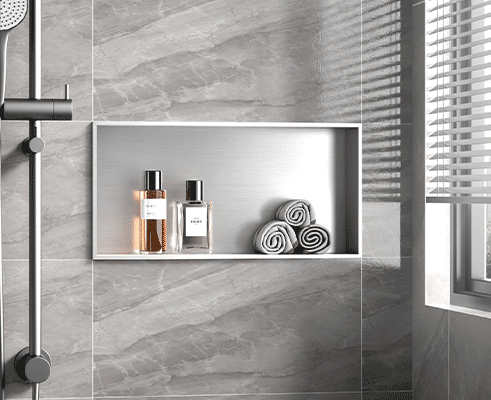
In modern interior design and architectural layouts, incorporating minimalist, recessed wall storage is an effective way to optimize spatial utility while maintaining a clean visual flow. Traditio...
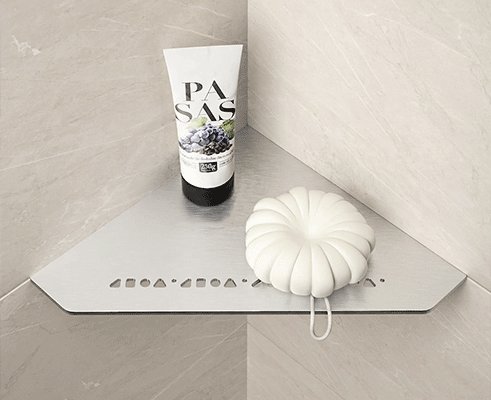
In luxury residential and commercial bathroom design, optimizing shower corner space with durable, corrosion-resistant storage is essential for both functionality and aesthetic appeal. Traditional...
Tile Profiles for Transitions
SB158 304 Stainless Steel Transition Profiles: Engineered Fl...
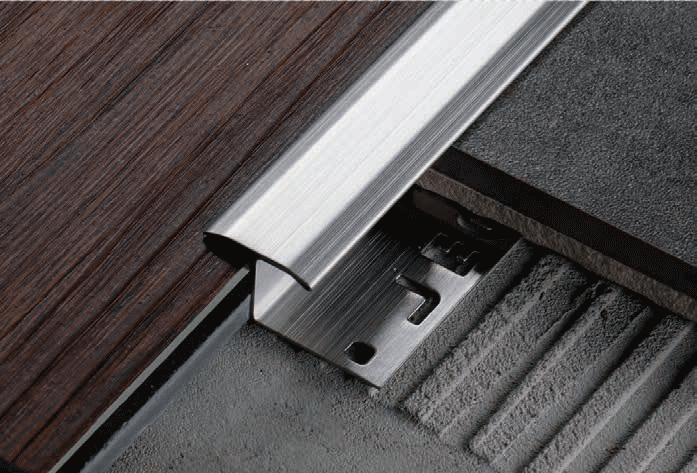
Modern flooring layouts frequently transition between distinct materials such as ceramic tiles, natural stone slabs, engineered wood, laminate planks, and resilient floorboards. Without precision-...
Contact JECA Decor
Custom Solutions for Global Projects
Established in 2012, we specialize in high-end decorative accessories. With over ten years of industry experience, we are committed to the product philosophy of "Safety, Practicality, and Advanced Technology".
- ISO9001 Quality Management System
- EU CE certification
- IPMS (Intellectual Property Management System)
- Australian, American, and Canadian standards
We are located in Foshan, Guangdong, just under one and a half hours' drive from Guangzhou Baiyun International Airport, in the heart of the Pearl River Delta Economic Zone.
If you are interested in any of our products, or would like to discuss a custom order, please feel free to contact us. We look forward to building long-term business relationships with clients around the world.