Stainless Steel vs. Aluminum Skirting Profiles: Which to Specify for Commercial Projects?
Choosing a skirting profile looks like a minor line item in a specification — until a hotel corridor takes delivery carts into its walls, or a hospital audit flags a hygiene risk at the floor-to-wall junction. The two metals that dominate commercial skirting specifications, stainless steel and aluminum, solve different problems. Picking the wrong one usually shows up two years later as dents, discoloration, or a premature replacement order.
This guide compares both materials across the criteria that actually matter to architects, contractors, and procurement teams: durability, corrosion resistance, cost, finish options, and installation.
Why Skirting Profiles Matter in Commercial Buildings
In residential work, skirting is decorative. In commercial projects it is protective infrastructure: it absorbs trolley and vacuum impacts, covers the joint between wall finish and floor, resists cleaning chemicals, and — when properly detailed — supports hygienic, cove-like transitions that pass inspection in hospitals, kitchens, and cleanrooms.
That’s why the material choice is not purely aesthetic. A profile that looks identical in a catalog can perform very differently under daily commercial wear.
Stainless Steel Skirting Profiles: Strengths & Limitations
Superior impact and wear resistance
Stainless steel skirting, typically formed from 304 (or 316 for aggressive environments) at 0.6–1.0 mm thickness, resists dents and deformation far better than aluminum. In high-traffic corridors — hotels, airports, hospitals, schools — this is the single biggest argument for steel. Where housekeeping carts, luggage, and equipment routinely strike the wall base, stainless steel maintains its line for years.
Corrosion resistance and hygiene
304 stainless steel stands up to most commercial cleaning agents, and 316 adds molybdenum for chloride-rich environments such as pools and coastal buildings. The non-porous surface wipes clean easily, which is why stainless steel trim is the default specification in healthcare and food-service projects. A caveat worth reading before you approve samples: not all “304” labels are genuine — verify the grade before it reaches your site.
Higher material cost and weight
The trade-offs are price and handling. Stainless steel costs more per meter than aluminum, weighs more, and cutting it on site requires proper tools. For projects where the budget drives the baseboard decision, that matters.
Typical specification: our SY044 304 stainless steel skirting tile profile is a common choice for hotel corridors, hospital wards, and elevator lobbies where impact and hygiene are priorities.
Aluminum Skirting Profiles: Strengths & Limitations
Lightweight, economical, and fast to install
Aluminum skirting profiles are roughly one-third the weight of steel equivalents and easier to cut and fix on site. For large floor plates — office fit-outs, retail chains, residential towers — that translates into lower installed cost and shorter program times.
Design flexibility: colors and integrated lighting
Aluminum extrudes easily, which unlocks options steel cannot match economically: slim low-profile sections, rounded baseboard shapes, and — most significantly — integrated LED channels. Anodized finishes hold color well, and powder coating delivers any RAL tone to match the wall system. If the design brief includes cove lighting or a skirting that doubles as a light source, an aluminum LED baseboard channel is often the only sensible answer.
Softer surface, more visible denting
Aluminum is a softer metal. In back-of-house areas, service corridors, and anywhere with wheeled traffic, an aluminum skirting will show dents and scratches earlier than stainless steel. Anodizing improves scratch resistance but does not change the underlying hardness.
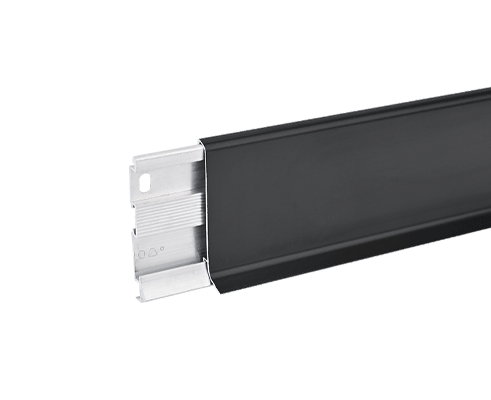
Typical specification: our AD788 aluminum skirting profile suits office interiors, retail units, and residential common areas where clean lines and budget efficiency matter.
Head-to-Head Comparison
| Criteria | Stainless Steel Skirting | Aluminum Skirting |
| Impact resistance | Excellent | Moderate |
| Corrosion resistance | Excellent (304/316) | Good (anodizing-dependent) |
| Weight | Heavier | ~1/3 lighter |
| Cost per meter | Higher | Lower |
| Finish options | Hairline, mirror, BA, PVD colors | Anodized, powder-coated, wood-look |
| LED integration | Limited | Excellent (dedicated channels) |
| On-site workability | Harder to cut | Easy to cut and fix |
| Best fit | Hotels, hospitals, airports, wet areas | Offices, retail, residential, feature lighting |
Which Should You Specify? Scenario Guide
- Hotel corridors, hospitals, airports, schools → Stainless steel (304). Impact and hygiene dominate.
- Coastal buildings, pool surrounds, chemical plants → 316 stainless steel. Chloride resistance is non-negotiable.
- Corporate offices, showrooms, retail → Aluminum, anodized. Budget, color matching, and clean profiles win.
- Design-led lobbies and residential towers → Aluminum LED baseboard channels, or PVD-coated stainless steel where a gold or black metallic line is specified.
- Mixed projects → A common and cost-effective approach: stainless steel in service and high-traffic zones, aluminum in guest-facing low-impact areas.
Installation and Maintenance Notes
Both systems install on adhesive or mechanical fixing, but plan the junction with the floor finish early: tile, stone, LVT, and carpet each need a different base detail. For the floor-to-floor side of that junction, see our guide to floor transition profiles. Maintenance is minimal for both materials — pH-neutral cleaners, no abrasive pads on brushed or mirror finishes, and periodic inspection of external corners where impact concentrates.
Frequently Asked Questions
Is stainless steel skirting worth the extra cost over aluminum? In high-traffic commercial areas, yes. The life-cycle cost favors steel wherever impacts are frequent, because dented aluminum skirting is visible and expensive to replace floor by floor.
Can aluminum skirting be used in bathrooms? Yes, with anodized or powder-coated finishes and correct detailing at wet joints. For showers and fully wet rooms, 304 stainless steel remains the safer specification.
What thickness should commercial skirting profiles be? 0.6–1.0 mm is standard for metal skirting. Specify the higher end of the range for corridors with wheeled traffic.
Can I order custom heights or colors? Yes. Both stainless steel and aluminum skirting are available as OEM/ODM custom profiles with custom heights, radii, finishes, and punching patterns.
Conclusion
There is no universal winner — the right skirting material follows the traffic, the moisture, and the design intent of each zone. Stainless steel buys durability and hygiene; aluminum buys flexibility, color, and cost efficiency. Many of the best commercial specifications use both.
Planning a commercial project? Explore JECA Decor’s full skirting and trim range or request free samples for specification approval — produced in our own Foshan forming lines, with OEM/ODM support from drawing to delivery.
Contact JECA DECOR
Explore JECA DECOR products
Obliquity Profiles and Glass Profiles
SF217 Stainless Steel Glass Profiles & Obliquity Profile...
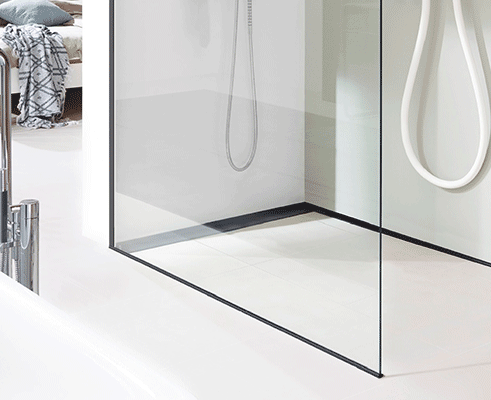
In modern architectural bathrooms and barrier-free walk-in shower designs, securing fixed glass panels while covering floor slope transitions (sloped drainage zones) requires specialized structura...
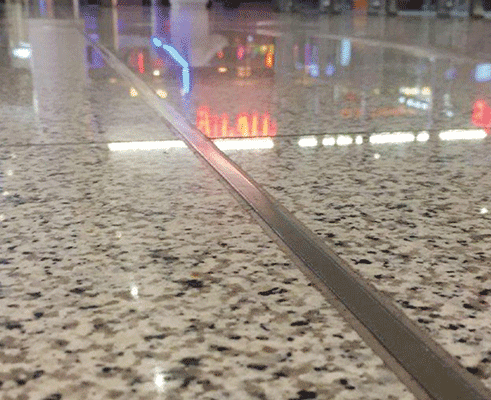
Expansive ceramic tile and natural stone floor installations across modern commercial facilities require reliable movement control to counteract thermal expansion, substrate settlement, and mechan...
Skirting Profiles
SY044 Skirting Profiles: 304 Stainless Steel Skirting Tile P...
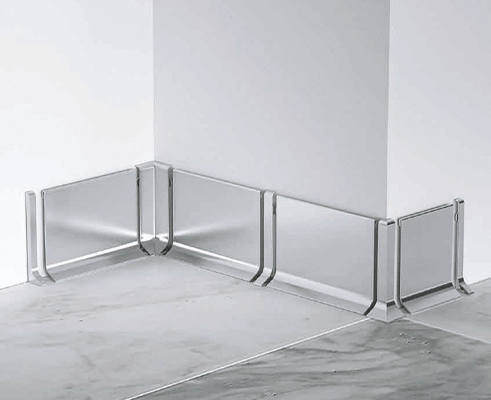
SY044 is a 304 stainless steel skirting profile, 80mm high × 2440mm long, formed in 0.8mm or 1.0mm and PVD coated. It closes the wall-floor junction with a hard metal face that does not need painti...
Contact JECA Decor
Custom Solutions for Global Projects
Established in 2012, we specialize in high-end decorative accessories. With over ten years of industry experience, we are committed to the product philosophy of "Safety, Practicality, and Advanced Technology".
- ISO9001 Quality Management System
- EU CE certification
- IPMS (Intellectual Property Management System)
- Australian, American, and Canadian standards
We are located in Foshan, Guangdong, just under one and a half hours' drive from Guangzhou Baiyun International Airport, in the heart of the Pearl River Delta Economic Zone.
If you are interested in any of our products, or would like to discuss a custom order, please feel free to contact us. We look forward to building long-term business relationships with clients around the world.