Import Tile Trim from China: MOQ, Lead Time & Incoterms Guide
Trim is 1–2% of an FF&E budget and about 30% of the schedule risk. On a 300-key hotel you need roughly 4 km of it, and every metre has to be on site before the tiler starts that wall — not before handover.
Sourcing playbook · JECA Decor, Foshan · 12 min read
Most trim orders that go wrong were never really about trim. They were about a finish approved without a physical sample, a lead time that started on a date nobody wrote down, or a bill of lading that disagreed with the invoice. All of it is decided at purchase-order stage, and all of it is avoidable with about twenty minutes of prep.
This is the version of that twenty minutes we hand to project buyers.
The short answers
| Typical MOQ, stock profile and colour | 300–500 m |
| Typical MOQ, any named colour | 500–1,000 m per colour |
| Quoted production lead time | 15–25 days after deposit |
| Realistic door-to-door | 9–12 weeks |
| When to place the order | 12 weeks before tiling starts |
| Cheapest sensible Incoterm | FOB named port, your forwarder, your insurance |
| Documents worth refusing to pay without | Mill certificate, coating report, salt-spray hours, packing list with lot numbers |
| Payment that keeps you safe | 30% deposit / 70% against B/L copy, after inspection |
First, the number nobody quotes: trim is air, not weight
A stainless tile trim section weighs somewhere between 0.3 and 0.6 kg per metre. A 1,000 m order — a normal size for a mid-rise hotel — comes to roughly 700 kg and around 3.5 cubic metres once it is bundled and cartoned.
That ratio is the most important number in the landed cost, because ocean freight charges whichever is greater: weight or volume. At about 200 kg per cubic metre, trim is pure volumetric cargo. You are not paying to move metal. You are paying to move the empty space inside the bundles.
What this does to your freight decision
- LCL is charged per cubic metre, with a minimum. A 3.5 CBM shipment often bills at 4–6 CBM after rounding, plus a destination CFS handling charge that does not shrink with volume. For anything under roughly 8 CBM, price an LCL quote against a 20ft container before you accept it — the gap is usually smaller than buyers expect, and the FCL removes the co-loading damage risk entirely.
- Length and container type must be decided together. A 20ft container has about 5.9 m of internal length; a 40ft has 12.03 m. Cut at 2.5 m and a 20ft wastes almost nothing. Specify 3 m and you leave a metre of unusable length at the door of every 20ft — which is why factories quietly standardise on 2.44 m and 2.5 m rather than 3 m.
- The bundle is the damage vector. Not the carton, the bundle. Any quote that does not mention edge protection, end caps and how bundles are strapped is a quote for a claim. We wrote a separate note on how trim is packed for ocean freight, because it is the difference between a clean delivery and a snag list.
Rule of thumb for landed cost. On a project order of 1–5 CBM to the US or EU, budget FOB value × 1.25–1.40 as your landed number, before duty. The multiplier covers freight, origin charges, destination charges and clearance. It is not a quote — but it is close enough to sanity-check a supplier who claims the freight is “almost nothing”.
MOQ: one number, four hidden minimums
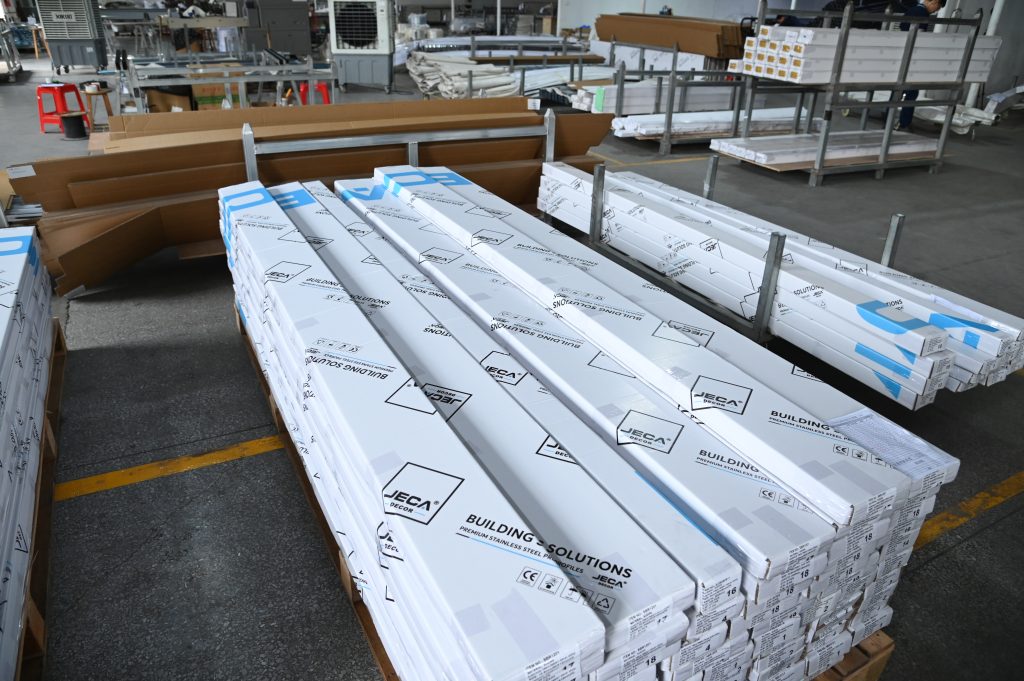
When a factory says “MOQ 500 metres”, that figure is not a policy. It is where four separate production constraints happen to land. Knowing which one is binding is how you negotiate in metres instead of accepting a number.
| Constraint | What drives it · how to push back |
|---|---|
| 1. Extrusion run | A 6063-T5 die has to be mounted and stabilised, and the first part of any run is scrap. Stock dies: a few hundred kilos. New dies: higher, because tooling is amortised into order one. Long thin decorative sections need a bigger press than a chunky skirting of the same length, so they carry a higher minimum — push back by using a stock section for the run you can hide. |
| 2. Finishing batch usually the real floor | PVD is a vacuum chamber cycle: ten metres of champagne gold and two thousand metres cost nearly the same machine time, so partial loads and colour changes get refused. Anodising needs a dye bath per colour. Powder coating needs a booth purge per colour. This is why MOQ is quoted per colour, and why it is the number worth arguing about. |
| 3. Packing | Cartons are printed and sized per profile. Small runs get hand-packed, which is where dented edges and missing end caps come from. On a first order ask for neutral cartons — printed cartons carry their own minimum print run and add roughly two weeks. |
| 4. Length | Non-standard lengths raise scrap and raise the effective minimum. Cutting a 2.5 m profile down on site with a carbide blade costs less than the upcharge for a custom length, almost every time. |
The MOQ levers that actually work
- Cut the colour count. Colour is the biggest single multiplier. Two warm finishes across a whole project will usually clear MOQ where five will not.
- Make one colour the frame. Pick one colour for every visible profile in the project and use the second only where it is meant to be noticed. A design decision that happens to halve your minimums.
- Send a physical sample, never a photo. A lab match to a physical standard is a fee. A mismatch is a re-order, a re-install and a client conversation.
- Standardise hole spacing. One jig can serve every punched profile on the project; five spacings means five set-ups.
- Consolidate into one shipment. One order of 3,000 m across four profiles in two finishes beats three orders of 1,000 m on price, on freight, and above all on colour: a single finishing batch means the tenth floor matches the fourth. Split the batch and it will not.
What to say when MOQ is too high. Don’t ask for a discount on the minimum — ask which constraint is binding. “Is the floor the extrusion or the PVD batch?” gets a different answer, and often a different price, than “can you do 200 metres?”. If it is the finishing batch, ask to be added to an existing run of the same colour. Factories schedule PVD weekly; riding someone else’s cycle costs nothing, and nobody offers it unless you ask.
The 20-day quote and the 11-week reality
The lead time on a quotation is measured from a trigger: deposit received and pre-production sample approved. Everything before that trigger, and everything after the factory gate, is excluded — and that is where most of the schedule lives.
| Stage | Realistic duration |
|---|---|
| PO issued → deposit cleared | 3–7 days |
| Golden sample / colour match approved | 5–10 days (+7 if a physical lab match is needed) |
| New die fabrication | 10–18 days |
| Extrusion and fabrication | 5–10 days |
| Surface finishing | 3–8 days, batch-queue dependent |
| QC, packing, photos | 2–4 days |
| Booking, trucking, China export clearance | 3–7 days |
| Ocean transit — Asia to USWC | 14–20 days |
| Ocean transit — Asia to USEC / North Europe | 30–40 days |
| Ocean transit — Asia to Australia | 12–18 days |
| Destination port, customs, drayage | 5–12 days |
Total it and the “20-day” factory is a nine to twelve week programme. Which produces the one scheduling rule that matters more than any other on this page:
Release the PO twelve weeks before the tiler needs material — not twelve weeks before handover. Trim looks like a finishing item and behaves like a first-fix item. Every edge, corner, threshold and niche frame has to be on site before the first tile goes down on that elevation. A shortage does not slow the end of the job. It stops the job.
Three calendar traps, in order of how often they bite
Chinese New Year
6 February 2027. Production effectively stops for the two weeks around it, and the three weeks before are consumed by finishing existing orders and clearing the port. A February vessel means a November order.
National Day, 1–7 October
Short, but it lands inside the pre-Christmas shipping peak, so the combined hit on vessel space is worse than the holiday alone.
Peak season space
August to October, then again in January. Rates and roll-over risk both climb; book six weeks out on project cargo of any size.
Ask for dates, not ranges
“15–25 days” is not information. A production schedule with a die-mounting date, an extrusion date, a finishing batch date and a packing date is. The finishing batch date is the one to hold onto — PVD chambers run weekly or fortnightly, and missing the slot costs a full cycle, not a day.
Certifications: six documents, and the exact question to ask for each
Three completely different kinds of paper get called “certification”, and they answer three different questions. Blur them and you end up with a folder that does not say what you think it says.
| Document | What it actually proves | Ask this |
|---|---|---|
| ISO 9001 certificate | The factory runs an audited quality system. Says nothing about the metal in your carton. | “Who is the certification body, and what is the certificate number?” |
| Mill test certificate (EN 10204 3.1) | Chemistry and mechanicals of the coil the profile was made from, issued by the steel mill. | “Can you trace this lot number back to the mill certificate?” |
| Third-party lab report | What one sample did, under one method, on one date. | “What is the report date, and does the method match my spec?” |
| CE marking / DoP | Conformity with a harmonised EU standard — where one exists for the product. For tile trims generally it does not. For metal beads used with plasterboard, EN 14353 applies. | “Which harmonised standard is the declaration made against?” |
| REACH SVHC / RoHS | No restricted substance above threshold. Often a self-declaration. | “Is this self-declared, or is there a lab test behind it?” |
| EN 13501-1 reaction to fire | Solid metal achieves A1. The coating system is the part worth checking on large ceiling runs. | “Is the classification for the coated product or the bare metal?” |
A logo printed on a carton is a design decision, not evidence. The question that separates a factory from a trading company is slightly uncomfortable and worth asking anyway: which standard, tested by which body, on what date, and can I see the report?
Verify the grade in thirty seconds at goods-in
Highest return on effort of anything in this guide. A handheld XRF unit tells you whether the “304” you paid for is 304, 201, or a decorative name with no standard behind it.
- 304 — nickel 8.0–10.5%, chromium 18–20%, manganese under 2%, molybdenum near zero.
- 316 — as above plus molybdenum 2.0–3.0%. The grade for coastal, pool and de-icing-salt exposure.
- 201 — nickel 3.5–5.5%, manganese 5.5–7.5%. Cheaper, work-hardens fast, and will rust at a cut edge in a wet room inside a season.
The tell is the combination: low nickel together with high manganese is 201, not 304. For the spark test, the magnet myth and the other field checks, see four ways to spot fake 304 before it reaches a hotel project.
Write test methods into the PO, not brand names
Substrate grade gets the attention; the coating is what fails first. There is no harmonised standard for PVD, so you specify the method and the number:
- Film thickness — XRF. Decorative PVD on trim runs 0.3–1.0 µm. On hand-contact surfaces thin is not a saving, it is a service life measured in months.
- Adhesion — ISO 2409 cross-cut, class 1 or better.
- Corrosion — ISO 9227 neutral salt spray, with hours stated: 96–240 h interior, 480 h and up for exterior or pool.
- Abrasion — Taber CS-10, with cycles and haze change recorded.
- Anodising — EN ISO 7599, film class 15 or 20 µm for architectural work, plus a seal test.
- Powder coating — EN 12206-1, 60–80 µm for external architectural use.
- Slip resistance on stair nosing — DIN 51130 R-class or a BS 7976 pendulum value, depending on market.
If a supplier cannot state the salt-spray hours their champagne gold achieves, they have not tested it. That is a useful answer too.
Incoterms: choose one, then write down these four things
An Incoterm divides cost, risk and obligation. It does not transfer title and it does not replace the contract. Most trim freight disputes are not about which term was chosen — they are about nobody writing down the port, the forwarder, and who pays the origin charges.
| Term | Use it when | The trap |
|---|---|---|
| EXW Foshan | Almost never | Your forwarder handles China export clearance, and a factory that has never shipped EXW may not produce the export documents your broker needs. |
| FCA Foshan / Shenzhen | You book the container | Technically the correct term for containerised cargo, because the seller hands over at the yard rather than on board. Undervalued only because banks and L/Cs still expect FOB. |
| FOB named port | Default choice | Two things to fix in writing: which port — Foshan and Shenzhen are three hours apart — and who pays origin THC and documentation. “FOB” leaves that ambiguous in practice. |
| CFR / CIF | You want a simple landed estimate | CIF insurance is Institute Cargo Clauses (C) at minimum: excludes theft, water damage and breakage. On trim, breakage and denting are exactly the risk. Buy your own all-risks cover. |
| DAP site | You have a broker and a site that takes a 40ft trailer | You are the importer: duty, VAT, clearance and unloading are yours. |
| DDP site | Small, simple, low-risk goods only | The term with the most hidden liability. The seller is either importing in their own name without a registration in your country, or using a nominee importer who owns the declaration. If an under-declaration surfaces later, exposure follows the declaration, not the invoice. |
The four lines that prevent most freight arguments. In the PO, state: (1) named port, (2) named forwarder, (3) container type and cut-off date, (4) which origin charges are included. Ninety per cent of “the freight came in over budget” stories start with one of those four missing.
HS codes, duty and the questions a supplier cannot answer
Classification of trim is genuinely ambiguous, and the rate follows the code. Stainless trim can sit in 7326.90 as an article of iron or steel, 7222.40 as a stainless section, or 7308.90 as a part of a structure. Aluminium trim can go to 7604.29 as a profile or 7616.99 as an article. The dividing line is whether customs reads the goods as a raw profile or a finished article — and the rates differ.
Settle the code before the PO, not after. At volume, a binding ruling from the destination authority ends the argument permanently. Put the agreed code on the purchase order so the invoice, packing list and declaration all agree — mismatched paperwork is the most common reason a container sits at destination for a week.
Ask your broker, not your supplier, about trade measures. US Section 301 lists and the Section 232 derivative product list have both been amended repeatedly, and the rate for your line moves with them. On the anti-dumping side, aluminium extrusions from China sit under US AD/CVD orders, and whether a specific trim profile falls inside the scope depends on the scope language — a broker or trade counsel question. Stainless trim is generally outside that scope.
If the answer to a duty question is “no problem, we declare it as samples”, that is not flexibility. It is a liability being transferred to whoever is named importer of record, which is probably you.
Ten traps that cost projects weeks
- Approving a finish from a screen. A photo of a sample is not a sample. Neither is a colour name. Get the physical piece, hold it against the tile, and sign it.
- Treating the quoted lead time as door-to-door. It starts at deposit and ends at the factory gate. Everything outside those two points is your calendar, not theirs.
- Ordering trim after the tile is on site. The most expensive sequencing error on the project, and the most common. Trim goes in with the tile, elevation by elevation.
- Forgetting that every colour is a separate batch. Five profiles in one colour is one run. Five profiles in three colours is three runs, three minimums and three chances of a half-shade drift.
- Accepting CIF and assuming you are insured. Clauses (C) will not pay for a dented bundle, and dented bundles are what actually happen.
- Letting the invoice and the declaration disagree on the HS code. The container does not move until somebody pays to fix it, and that somebody is the importer.
- Skipping the pre-shipment photo. One photo of the finished pallet, before the doors close, catches a wrong colour while it is still 200 metres from the packing line instead of 8,000 km away.
- Leaving protective film on through a summer. Adhesive transfers into the finish and no solvent gets it out cleanly. Specify a removal window, and put it in the site instructions, not only the PO.
- Buying on unit price alone. A 6% cheaper profile with a 0.2 µm coating on a door push plate will be replaced before the defects liability period ends.
- Paying the balance before inspection. The balance is the only leverage you have. Tie it to an inspection report, not to a date.
How to test a factory for the price of a sample order
Before a project order, spend a few hundred dollars and learn more than any brochure will tell you. Ask for 3–5 metres of one profile in the project colour, and pay the sample premium — expect roughly 1.5–2× the unit price plus courier. That is normal, not a red flag.
Then judge the sample on six things, in this order:
- Does the colour match the master? Look at it under the actual project CCT, not office lighting.
- Are the cut ends clean and square? Crooked cuts mean a worn saw or an unskilled operator.
- Is the protective film flat, with no trapped air or adhesive bleed?
- Does the coating survive a fingernail and a coin? A decorative layer that marks under a coin will not survive a hotel.
- Do the end caps fit? Loose caps are a packing problem that becomes a snag list.
- Was the paperwork right? A sample that arrives with a packing list, a lot number and a coating report comes from a factory that will do the same at 3,000 metres.
The RFQ that gets a usable quote first time
Most quotes come back vague because the enquiry was vague, and a vague quote is where the arguments start. Send this instead — eight lines, one page.
Copy this into an e-mail
Subject: RFQ – [Project name] / [qty] m tile trim / delivery by [date]
- Profile: [model no. or drawing attached]
- Substrate: 304 / 316 / 6063-T5
- Finish: [PVD / anodised / powder] in [colour], reference [sample ref]
- Quantity: [x] m of [profile], [x] m of [profile], by finish
- Length: [2.5 m] / [custom], packed [x] pcs per carton
- Documents required: mill certificate, coating thickness, salt-spray hours, packing list with lot numbers
- Terms: FOB [named port], [container type], cut-off [date]
- Target dates: samples by [date], production complete by [date], on site by [date]
Please confirm: MOQ per line, a production schedule with dated milestones, and which origin charges your FOB price includes.
That last sentence is doing real work. It forces the supplier to put origin charges in writing, which is the most common place a “cheap” FOB quote turns expensive.
Twelve-line checklist before you sign
- Profile drawing approved, with tolerances and visible faces marked.
- Substrate grade per profile: 304, 316 or 6063-T5.
- Finish process named — PVD, anodised or powder — plus colour reference and a physical master.
- Colour tolerance as ΔE against the master; gloss level in gloss units.
- Coating test methods and pass thresholds listed.
- Quantities by profile, finish and length, with the minimum each line triggers confirmed.
- Lengths, carton quantity, end caps, film type and removal window.
- Production schedule with dates, not a range.
- Inspection scope: what is measured, what is photographed, who signs.
- Documents travelling with the shipment, itemised.
- HS code, Incoterm, port, container type, cut-off, origin charges.
- Payment tied to inspection, not to a calendar date.
Two things that are not on the list because they are not documents. Ask for a photo of the finished pallet before the container is sealed — it costs nothing and catches a wrong colour while it is still fixable. And ask who at the factory owns your order. A name, not a department.
The awkward truth about importing trim is that the product is simple and the logistics are not. A trim profile is a piece of formed metal with a coating on it. But between a four-thousand-dollar order and a finished hotel floor sit batches, cut-off dates, classifications and signatures — and all of them are settled on paper before anyone picks up a trowel.
If you are costing a 2027 project and want the numbers against your own schedule rather than a market range, send us the elevations and the finish schedule. We manufacture in Foshan, ship to over a hundred countries, and would rather argue about your Incoterm now than about a missing pallet in eleven weeks.
Still choosing the finish? Our note on champagne gold, rose gold and the 2027 trim palette covers which finishes are worth specifying, and where each one fails.
Contact JECA DECOR
Explore JECA DECOR products
Expansive ceramic tile and natural stone floor installations across modern commercial facilities require reliable movement control to counteract thermal expansion, substrate settlement, and mechan...
Ceiling Profiles
ALE8073 Ceiling Profiles: Precision Aluminum Solutions for M...

In contemporary interior architecture and luxury space design, creating clean perimeter shadow gaps, indirect LED lighting coves, and seamless transitions between ceilings and walls requires speci...

In luxury residential and commercial bathroom design, optimizing shower corner space with durable, corrosion-resistant storage is essential for both functionality and aesthetic appeal. Traditional...
Contact JECA Decor
Custom Solutions for Global Projects
Established in 2012, we specialize in high-end decorative accessories. With over ten years of industry experience, we are committed to the product philosophy of "Safety, Practicality, and Advanced Technology".
- ISO9001 Quality Management System
- EU CE certification
- IPMS (Intellectual Property Management System)
- Australian, American, and Canadian standards
We are located in Foshan, Guangdong, just under one and a half hours' drive from Guangzhou Baiyun International Airport, in the heart of the Pearl River Delta Economic Zone.
If you are interested in any of our products, or would like to discuss a custom order, please feel free to contact us. We look forward to building long-term business relationships with clients around the world.